


Quick Summary
Mimosa hostilis and Mimosa pudica belong to the same genus, but their growth forms and most recognizable traits differ. Mimosa hostilis, now accepted botanically as Mimosa tenuiflora, grows as a woody shrub or tree, while Mimosa pudica is a smaller annual, perennial, or subshrub. Mimosa pudica is famous for folding its leaves when touched, while Mimosa hostilis does not display the same characteristic touch response. Mimosa hostilis is also commonly associated with its distinctive root bark, while Mimosa pudica is better known as the sensitive plant.
The mimosa hostilis vs. mimosa pudica comparison can be confusing because both plants belong to the Mimosa genus and share delicate, compound foliage. Their similarities largely end there, since they differ in growth habit, touch response, appearance, and the plant material people commonly encounter. These differences give each species a distinct botanical identity.
The mimosa hostilis vs. mimosa pudica comparison can be confusing because both plants belong to the Mimosa genus and share delicate, compound foliage. Their similarities largely end there, since they differ in growth habit, touch response, appearance, and the plant material people commonly encounter. These differences give each species a distinct botanical identity.
Mimosa Hostilis Vs. Mimosa Pudica: How Are They Classified?
Mimosa hostilis is an older botanical name for Mimosa tenuiflora, a species in the Fabaceae family. Kew Science recognizes Mimosa tenuiflora as the accepted name and describes it as a scrambling shrub or tree native to parts of tropical America.
Mimosa hostilis root bark is one of the parts often encountered in botanical collections and natural dye contexts. That makes the species quite different from Mimosa pudica, which is more commonly recognized as a living sensitive plant rather than as processed bark material.
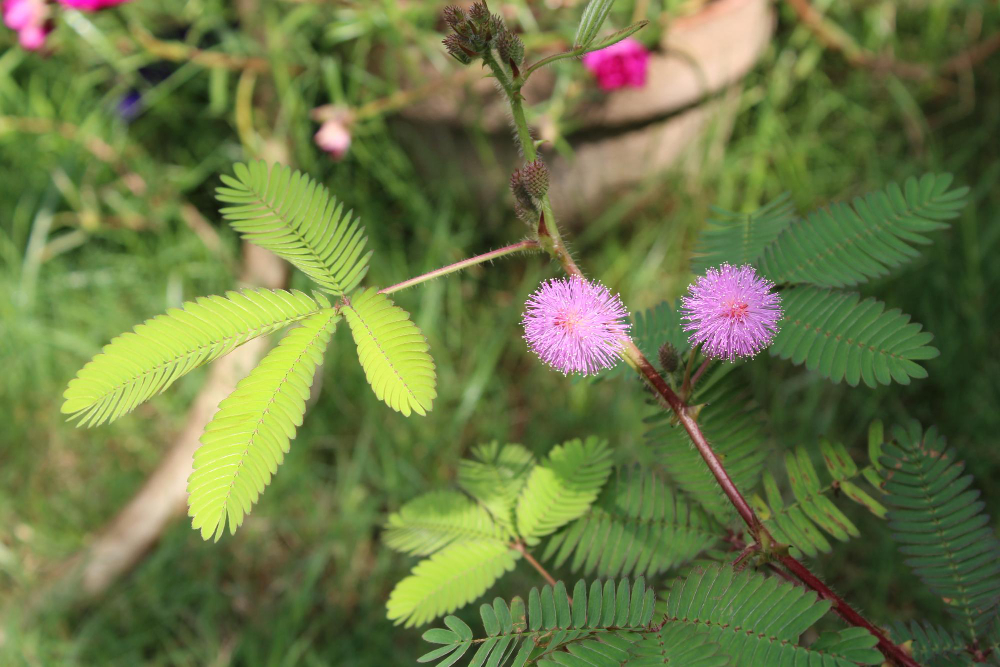
Mimosa pudica also belongs to the Fabaceae family and the Mimosa genus, but it is a separate species. It usually grows as a low, spreading herb or subshrub, giving it a softer and more compact form than Mimosa hostilis.
How Do Their Growth Habits Differ?
Mimosa hostilis can develop into a woody plant with multiple branches and a tree-like or shrubby profile. This growth pattern gives mature specimens a noticeably different structure from Mimosa pudica.
Mimosa pudica usually remains closer to the ground and may spread outward as it grows. Its slender stems and smaller size create the lighter appearance associated with the familiar sensitive plant.
The contrast becomes especially clear when mature plants are compared side by side in a garden or botanical collection.
This difference also helps with identification. A woody shrub or small tree points toward Mimosa hostilis, while a low plant with responsive leaves is more likely to be Mimosa pudica.
What Happens When You Touch Their Leaves?
Leaf movement is the easiest way to recognize Mimosa pudica. When touched or disturbed, its small leaflets fold inward and the leaf stalk may droop, creating the reaction that gives the plant names such as sensitive plant and touch-me-not.
Mimosa hostilis does not show the same dramatic touch response. Its leaves can look similar because they also contain many small leaflets, but they remain comparatively still after ordinary contact.
How Do Their Leaves and Flowers Compare?
Both species have compound leaves divided into numerous small leaflets. This shared feature creates the soft, fern-like appearance seen in many members of the Mimosa genus.
Their flowers differ in form. Mimosa pudica is known for rounded pink to lilac flower heads, while Mimosa hostilis produces pale, elongated flower spikes.
Appearance becomes especially useful when the touch response cannot be observed. Flower shape, growth form, and branching structure can all help distinguish one species from the other.
Why Is Mimosa Hostilis Root Bark More Common in Botanical Commerce?
Commercial interest in Mimosa hostilis often centers on its root bark instead of the living plant. The bark has a strong natural color and has a history of use in dyeing and other non-food botanical applications.
The physical form of the bark can differ considerably. Someone interested in mimosa hostilis root bark powder may encounter larger pieces instead, making the stated preparation an important part of comparing botanical materials.
A buyer comparing mimosa hostilis root bark for sale may likewise see chunky bark alongside shredded or powdered preparations. Checking the form listed with the product makes it easier to know exactly what type of botanical material is being considered.
What Is Mimosa Pudica Better Known for?
Mimosa pudica is strongly associated with its visible response to touch. Gardeners and plant enthusiasts often grow it because the folding leaves make plant movement easy to observe.
Its reputation comes from the living plant rather than from root bark products. It therefore appears more often in discussions about ornamental plants, botany, and plant behavior.
This gives Mimosa pudica a very different identity from Mimosa hostilis. Sharing a genus does not mean two plants will have the same traits, growth patterns, or common botanical forms.
Do Mimosa Hostilis and Mimosa Pudica Grow in the Same Regions?
Both species are native to parts of tropical America, so their geographic ranges overlap broadly. Mimosa hostilis occurs from southern Mexico into parts of South America, while Mimosa pudica has a wider tropical American range.
Location alone does not identify either species. Growth habit, flowers, touch response, and the form in which the plant appears offer much stronger clues.
This matters when comparing dried botanical material with a living specimen. Root bark cannot display leaf movement, so accurate labeling and botanical sourcing become more important.
Which Differences Matter Most?
The clearest difference is movement. Mimosa pudica folds its leaves after touch, while Mimosa hostilis does not show the same characteristic response.
Their physical forms also separate them. Mimosa hostilis grows as a woody shrub or small tree, while Mimosa pudica usually remains smaller, softer, and closer to the ground.
Their commercial identities differ as well. Mimosa hostilis is frequently encountered through root bark, while Mimosa pudica is better known as a sensitive ornamental plant.
Choosing the Right Botanical Material
Knowing the species name and product form helps prevent confusion between two plants that look related on paper. Buyers interested in Mimosa hostilis can check the botanical name, plant part, and preparation listed with the material.
Our Brazilian Mimosa Hostilis Root Bark Chunky at Professor Seagull's SmartShop is a good example of why form matters, since "chunky" immediately identifies the preparation. People interested in other distinctive botanicals may also recognize Banisteriopsis Caapi - Red as a separate species in our collection.
Two Mimosa Species With Distinct Identities
Mimosa hostilis and Mimosa pudica share a botanical family and genus, but their similarities should not obscure their differences. One is a woody species often associated with root bark, while the other is a low-growing plant famous for leaves that fold when touched.
Comparing growth form, leaf movement, flowers, and product type gives a clearer picture than relying on the word Mimosa alone. These characteristics explain why the two species should be considered separately.
Find Mimosa Hostilis Root Bark With Us
At Professor Seagull's SmartShop, we carry Brazilian Mimosa Hostilis Root Bark Chunky for adults interested in clearly labeled botanical specimens. Shop online to view the product details and browse our wider selection of distinctive botanicals.
FAQs
Are Mimosa hostilis and Mimosa pudica the same plant?
No. They belong to the same Mimosa genus, but they are separate species with different growth habits and physical characteristics. Kew Science recognizes Mimosa pudica as its own species and lists Mimosa hostilis as a synonym of Mimosa tenuiflora.
What is the easiest way to tell Mimosa hostilis and Mimosa pudica apart?
One of the easiest distinctions is their reaction to touch. Mimosa pudica is well known for folding its leaves after physical contact, while Mimosa hostilis does not exhibit the same characteristic movement. Their growth forms also differ, since Mimosa hostilis develops as a woody shrub or tree.
Is Mimosa hostilis also called Mimosa tenuiflora?
Yes. Kew Science lists Mimosa hostilis Benth. as a synonym of the accepted species Mimosa tenuiflora (Willd.) Poir. Both names may appear in botanical discussions and product descriptions, so recognizing the relationship can make plant identification easier.
Why is Mimosa hostilis root bark commonly discussed?
Much of the commercial and botanical interest in Mimosa hostilis centers on its inner root bark. It is known for its dark reddish-purple coloration and has been associated with natural dyeing, artistic applications, and ethnobotanical collections.

 Previous
